





Most passengers on the Titanic are remembered as names on a list. Archibald Butt was different. He was a trusted aide to two sitting U.S. presidents, a decorated Army officer, and a former journalist whose career had touched the highest levels of American public service — before it ended on April 15, 1912.
This article covers who Archibald Butt was, how his career progressed from reporter to presidential staff officer, what his rank of “major” actually meant, what brought him onto the Titanic, and how he is remembered today.
From Augusta to Washington — Archibald Butt’s Early Life and Career
Archibald Butt’s full name was Archibald Willingham DeGraffenreid Clarendon Butt. He was born on September 26, 1865, in Augusta, Georgia. His given name alone signals a certain Southern formality, but the man himself was known simply as “Archie” to those close to him.
He graduated from the University of the South in 1888. After college, he went into journalism, working for the Louisville Courier-Journal and later reporting from Washington for several Southern newspapers. That work gave him an early window into how government actually functioned.
Before he ever put on a uniform, Butt also served as first secretary to the U.S. ambassador in Mexico. That diplomatic role introduced him to government protocol, official ceremony, and the kind of precise, organized support that senior officials depend on.
When you look at this progression — reporter, diplomatic secretary, then Army officer — it starts to make sense why two presidents would eventually trust him with their daily schedules and official appearances. Each step built on the last.
Military Service and the Path to the White House
Butt entered military service in 1898, when the Spanish-American War brought a wave of enlistments. He served in the Philippines and Cuba, where his primary work was in quartermaster and logistics roles.
Quartermaster duty is not glamorous, but it is essential. It means organizing supplies, transportation, accommodations, and the administrative machinery that keeps a military operation running. Done well, it requires reliability, attention to detail, and the ability to work with people at every level of an organization.
Those are exactly the skills a president needs in a military aide. Butt’s effectiveness in logistics built a reputation for discretion and dependability. That reputation followed him to Washington.
President Theodore Roosevelt appointed Butt as his military aide in 1908. It was a natural fit — a man who had spent years making complicated operations run smoothly was now doing the same thing, just at the highest level of American civic life.
Aide to Two Presidents — Roosevelt, Taft, and the Role of Military Aide
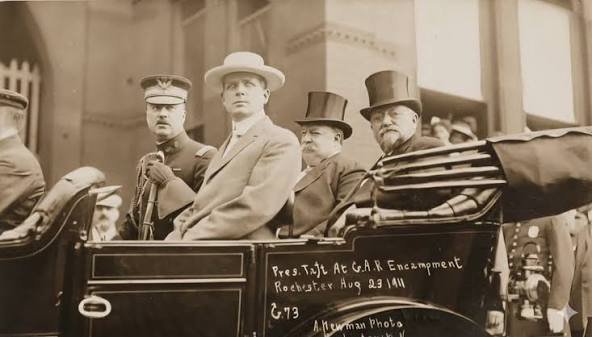
Butt began serving Roosevelt in 1908. When William Howard Taft became president in 1909, Butt stayed on without interruption. Serving two presidents in a row, across a change in administration, says something about how both men viewed him.
The military aide role is not a policy job. Butt was not advising the president on legislation or sitting in cabinet meetings. His work was closer to what a senior operations officer does — managing ceremony, coordinating travel, maintaining military customs and protocol, and making sure the president’s official appearances ran without problems.
Historical accounts describe Butt as particularly close to the Roosevelt family, not just the president himself. He was a constant presence in the Taft White House as well, trusted enough to be associated with Taft’s informal “Golf Cabinet” — the small circle of friends and companions the president relaxed with.
That kind of personal confidence matters. Presidents spend enormous amounts of time with their aides. They need someone who is competent, yes, but also someone they genuinely like and trust.
In 1911, President Taft promoted Butt to the rank of major. This is worth clarifying clearly: “Major” was an official U.S. Army rank, not an honorary title or a friendly nickname. When people refer to him as “Major Butt,” they are using his actual military designation.
Who Was Francis Millet, and Why Were They Traveling Together
Francis Davis Millet was an accomplished American artist and a director of the American Academy in Rome. He and Butt were close friends who moved in the same Washington social and cultural circles.
Both men boarded the Titanic at Southampton on April 10, 1912, traveling together in first class. Butt’s ticket number was 113050, and his cabin was B-38. They were returning from Europe — Butt had been on a rest trip, reportedly with Taft’s encouragement, as the pressures of presidential service had been wearing on him.
Historical sources — including Encyclopedia Titanica, the Smithsonian, and WETA Boundary Stones — consistently describe Millet as Butt’s close friend and traveling companion. Their friendship was well documented in Washington life, and their deaths together on the Titanic gave it a lasting historical dimension.
Some modern writers have explored interpretations of their relationship beyond friendship. Those interpretations should be understood as readings of limited historical evidence, not as confirmed biographical facts. What the record clearly shows is a close, long-standing friendship between two accomplished men who shared a social world in Washington.
The Titanic, His Death, and What Followed
The Titanic struck an iceberg on the night of April 14, 1912, and sank in the early hours of April 15. Both Archibald Butt and Francis Millet died in the disaster. Butt’s body was never recovered.
His death drew significant public attention — more than many other passengers — because he was personally known to two living former and current presidents. President Taft had corresponded with Butt regularly and considered him a genuine friend, not just a staff member. The Taft Papers at the Library of Congress include materials that reflect how much the loss affected the president.
News coverage at the time described Butt as having behaved calmly and with composure as the ship went down. Those accounts should be read carefully — eyewitness reports from disaster situations are often shaped by what survivors expected of certain people. What is confirmed is that he did not survive, and that his death was mourned at the highest levels of American public life.
For readers who enjoy exploring history through business and leadership profiles, StartBusinessBase offers context on how careers built on reliability, organizational skill, and trust still carry weight in any professional era.
How He Is Remembered Today
The most visible memorial to Archibald Butt is the Butt-Millet Memorial Fountain in Washington, D.C. The National Park Service maintains it today. The fountain was built to honor both Butt and Francis Millet, recognizing their friendship as well as their individual accomplishments.
Beyond the fountain, Butt appears in presidential history records, Titanic passenger databases, and military service archives. His full name turns up in genealogy research, historical collections, and Library of Congress materials related to the Taft administration.
He is not a household name in the way that presidents or generals are remembered. But within the history of presidential service, the Spanish-American War era Army, and the Titanic disaster itself, Archibald Butt occupies a specific and well-documented place.
A Life That Covered a Lot of Ground
Archibald Butt spent fewer than 47 years on earth. In that time, he worked as a journalist, served as a diplomatic secretary, fought in two overseas conflicts, and became the trusted personal aide to two U.S. presidents.
He was not a policy-maker or a public figure in the elected sense. His influence was quieter — the kind that comes from being indispensable to powerful people over a long period of time. Both Theodore Roosevelt and William Howard Taft trusted him, and that trust was clearly earned through years of steady, capable work.
When the Titanic sank, the country lost someone whose career had been genuinely useful, and whose relationships with two presidents reflected a kind of loyal, professional service that rarely makes the history books on its own. The Butt-Millet Memorial Fountain still stands in Washington as a reminder that he was there — and that his absence was felt.
Read Also: